
What Is Direct Response Marketing?
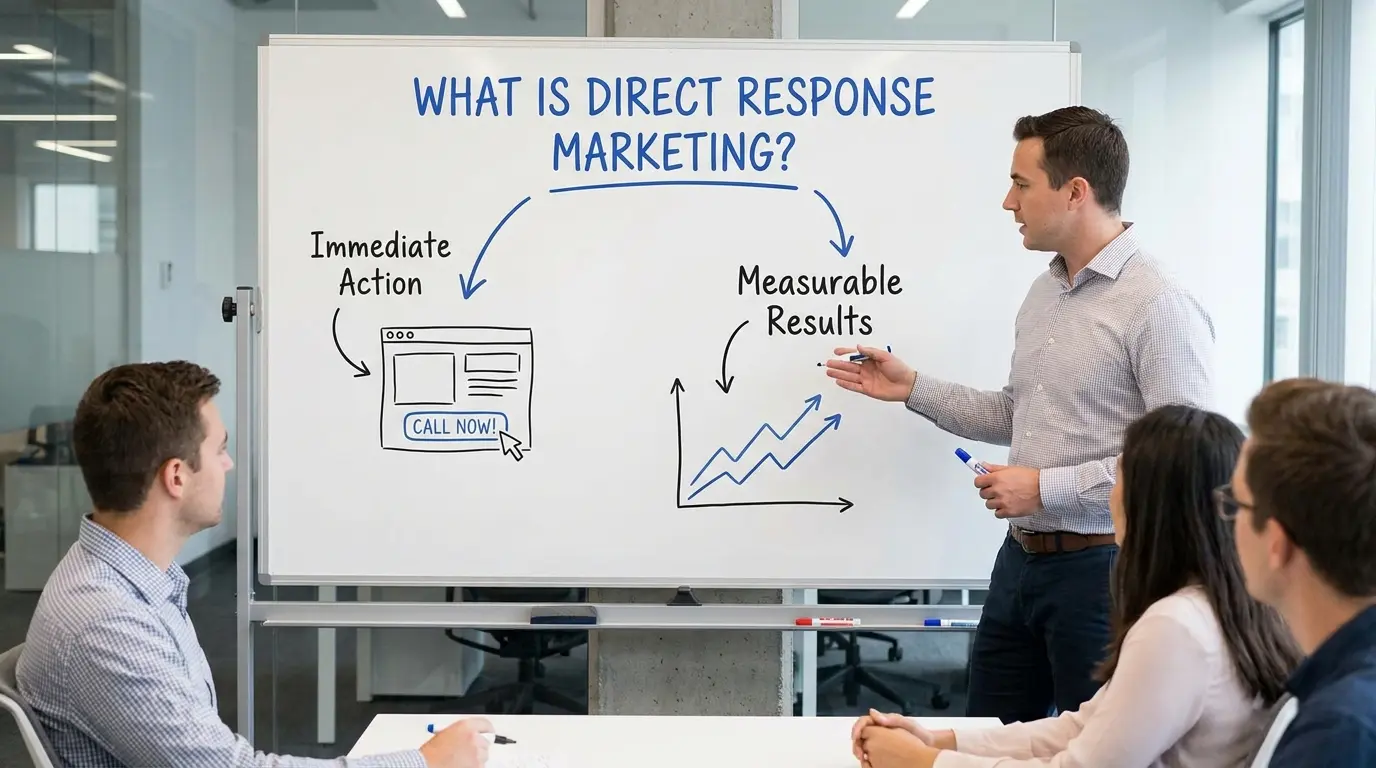
In today’s competitive digital world, businesses don’t just want attention, they want action. That’s where direct response marketing comes in.
Unlike traditional advertising that focuses mainly on brand awareness, direct response marketing is designed to make people take immediate action. Whether it’s clicking a link, signing up for a newsletter, buying a product, or booking a call, every campaign has one clear goal: generate a measurable response.
This strategy powers some of the world’s biggest brands, online stores, agencies, and creators because it delivers trackable results and fast feedback.
In this guide, you’ll learn what direct response marketing is, how it works, its benefits, strategies, examples, and how to build successful campaigns.
Table of Contents
What Is Direct Response Marketing?
Direct response marketing is a marketing strategy that encourages customers to take an immediate action after seeing an advertisement or promotional message.
Imagine you’re scrolling Instagram and you see an ad that says:
“Get 50% off today only , Click here to grab your deal”
You click. You buy. That’s Direct Response Marketing.
It’s the opposite of a Coca-Cola billboard that just shows a cold drink and hopes you feel good about the brand someday. DRM says: “Here’s what I want you to do. Do it now.”
The response could be:
- Buying a product
- Filling out a form
- Downloading an ebook
- Signing up for a webinar
- Calling a phone number
- Booking a consultation
The key difference is that the campaign is designed to create a direct and measurable response from the audience.
Instead of simply promoting a brand image, direct response marketing focuses on conversions.
How Direct Response Marketing Works
Direct response marketing is not just a communication style; it is a structured conversion system that moves a user from attention to action in a measurable way. In high-performing campaigns, every stage of the funnel is optimized using behavioral data, A/B testing, and performance benchmarks.
1. Capturing Attention (Top of Funnel Performance Reality)
The first stage is attention, and this is where most marketing fails. Industry research from advertising platforms consistently shows that average digital ad attention spans are extremely short, often under 3 seconds before a user decides to scroll or ignore.
For example, display ads typically have an average click-through rate (CTR) of around 0.5% to 1%, while well-optimized search ads can reach 3% to 6% CTR, depending on intent and targeting quality.
This difference happens because intent-based traffic responds better to direct response messaging.
A simple performance comparison looks like this:
| Ad Type | Average CTR | Visual Strength |
|---|---|---|
| Search Ads | 3% – 6% | ██████████ |
| Social Ads | 0.9% – 1.5% | █████ |
| Display Ads | 0.3% – 0.8% | ██ |
What this tells us is simple: attention is not random. It is heavily dependent on targeting accuracy and message relevance. High-performing campaigns use emotional hooks, problem-focused headlines, and visual contrast to interrupt scrolling behavior and force engagement.

2. Building Interest (Where Most Conversions Are Won or Lost)
Once attention is captured, the next phase is interest. This is where users decide whether the message is relevant to their problem.
Conversion research from landing page studies shows that average landing page conversion rates fall between 2% and 5%, but well-optimized pages in strong niches can exceed 10% to 15%.
The key factor is message match. If the ad promise and landing page message are aligned, conversion rates increase significantly. If there is mismatch, bounce rates can rise above 70%, meaning most users leave without interacting further.
At this stage, marketers rely on:
- Pain point amplification
- Benefit clarity
- Social proof placement
- Trust signals like reviews and case studies
A simplified funnel behavior pattern:
Start: 1000 users enter ad/funnel
↓
Attention Captured: 800 users remain
↓
Interest Stage: 300 users engaged
↓
Offer Consideration: 120 users interested
↓
Final Conversion: 20–50 customers
This shows how critical the interest stage is in filtering qualified users.
3. Presenting the Offer (Where Psychological Triggers Matter)
Offers are the conversion engine of direct response marketing. Data consistently shows that urgency and incentive-based messaging can increase conversion rates by 20% to 300%, depending on the industry and execution.
For example:
- Free trials increase SaaS conversions significantly because they reduce risk perception
- Limited-time discounts increase ecommerce conversions by triggering loss aversion
- Bonus stacking increases perceived value without lowering price integrity
Behavioral economics explains this clearly: people respond more strongly to avoiding loss than gaining something equivalent. This is known as loss aversion and is a key driver behind “limited time” campaigns.
4. Call-to-Action Execution (Final Conversion Gate)
The call-to-action is where intent becomes measurable action. Research from usability studies shows that reducing friction in CTAs can improve conversion rates by up to 25% to 50%.

Even small changes like button text, placement, or clarity can create measurable differences.
For example:
- Single focused CTA pages consistently outperform multi-option pages
- “Submit” performs worse than “Get Instant Access”
- Multiple CTAs reduce conversion focus and dilute performance
At this stage, clarity wins over creativity. If the user has to think too much, conversion drops sharply.
Why Direct Response Marketing Is So Effective
One of the main reasons direct response marketing is so effective is because it focuses on measurable results. Traditional advertising methods such as television commercials or billboards often make it difficult to know exactly how many customers were influenced by the campaign. Direct response marketing solves this problem by providing clear data and analytics.
Businesses can track conversion rates, click-through rates, cost per acquisition, and return on ad spend in real time. This allows marketers to identify what works and what does not. Campaigns can then be optimized continuously to improve performance.
Another reason for its effectiveness is personalization. Modern advertising platforms allow businesses to target very specific audiences based on interests, online behavior, demographics, and search intent. This means advertisements are shown to people who are more likely to respond positively.
Direct response marketing is also highly scalable. Once a business discovers a campaign that performs well, it can increase advertising budgets and expand audience targeting to generate even more leads and sales.
Direct Response Marketing vs Traditional Marketing
Although both marketing strategies are important, they serve different purposes. Traditional marketing mainly focuses on long-term brand awareness and reputation building. Companies use television advertisements, billboards, sponsorships, and print media to make their brands more recognizable over time.
Direct response marketing, on the other hand, focuses on immediate action and measurable outcomes. Instead of simply promoting a brand image, it encourages users to respond instantly through purchases, sign-ups, or inquiries.

For example, a traditional advertisement may focus on making consumers remember a brand name, while a direct response advertisement may offer a limited-time discount and encourage users to buy immediately.
Both strategies can work together effectively. Many successful businesses combine long-term branding with direct response campaigns to maximize growth and profitability.
Common Types of Direct Response Marketing
Direct response marketing appears in many forms across digital platforms.
Email marketing is one of the most common examples. Businesses send promotional emails with strong subject lines and compelling offers designed to encourage clicks and conversions. Flash sales, abandoned cart emails, and free trial offers are all examples of direct response email campaigns.
Social media advertising has also become a major part of direct response marketing. Platforms like Facebook,Instagram, andTikTok allow businesses to target highly specific audiences and optimize campaigns for conversions.
Pay-per-click advertising through Google Ads is another powerful direct response strategy because it targets users actively searching for products or services. Since these users already show buying intent, conversion rates are often much higher.
Landing pages are also essential in direct response marketing. These pages are specifically designed to convert visitors into leads or customers by using persuasive copy, testimonials, and strong calls-to-action.
Video marketing has become increasingly effective as well. Platforms likeYouTube allow brands to create engaging advertisements, product demonstrations, and customer success stories that encourage immediate action.
Benefits of Direct Response Marketing
Direct response marketing offers several advantages for businesses of all sizes. One major benefit is faster results. Unlike branding campaigns that may take months to influence customer behavior, direct response campaigns can generate leads and sales almost immediately.
Another major advantage is better tracking and analytics. Businesses can monitor campaign performance closely and make data-driven decisions. This reduces wasted advertising spend and improves profitability over time.
Direct response marketing also improves audience targeting. Instead of advertising to broad audiences, businesses can focus on people who are most likely to convert. This increases efficiency and lowers customer acquisition costs.
Scalability is another important benefit. Once a profitable campaign is identified, businesses can increase budgets and expand targeting to generate larger results. This makes direct response marketing highly attractive for companies focused on rapid growth.
Essential Elements of a Successful Direct Response Campaign
Successful direct response campaigns share several important characteristics. Strong copywriting is one of the most important elements. Headlines need to capture attention quickly while clearly communicating value. Emotional language, curiosity, and problem-solving approaches often improve performance significantly.
A compelling offer is equally important. Customers need a strong reason to act immediately. Discounts, bonuses, free trials, and exclusive deals can increase conversions dramatically.
Trust also plays a major role in campaign success. Testimonials, reviews, case studies, and social proof help build credibility and reduce hesitation. People are far more likely to respond positively when they see evidence that others have benefited from the product or service.
Another critical factor is urgency. Limited-time offers and scarcity tactics encourage users to act quickly instead of postponing their decision. Phrases such as “Offer Ends Tonight” or “Limited Spots Available” can increase response rates significantly.
Finally, the user experience must remain simple and clear. Complicated forms, confusing layouts, or too many choices can reduce conversions. The easier it is for users to take action, the better the campaign will perform.
Challenges of Direct Response Marketing
Despite its effectiveness, direct response marketing also has challenges. Advertising costs on digital platforms continue to rise as competition increases. Businesses need strong strategies and continuous optimization to remain profitable.
Ad fatigue is another common problem. Audiences may stop responding to repetitive advertisements over time, making it necessary to refresh creatives and messaging regularly.
Direct response campaigns also require constant testing and analysis. Marketers must monitor performance data, test different variations, and improve campaigns continuously to maintain strong results.
Another challenge is balancing short-term conversions with long-term branding. Businesses that focus only on immediate sales may struggle to build lasting customer relationships. The strongest companies usually combine direct response marketing with broader brand-building strategies.
The Future of Direct Response Marketing
Direct response marketing continues to evolve rapidly as technology advances. Artificial intelligence, automation, and predictive analytics are making campaigns more personalized and efficient than ever before.
Short-form video content is becoming increasingly dominant, especially on platforms like TikTok and Instagram Reels. Businesses are also investing heavily in personalized customer experiences and AI-driven advertising systems.
As consumer behavior continues to change, businesses that focus on data, creativity, and audience understanding will have the greatest success with direct response marketing.
Final Thoughts
Direct response marketing has become one of the most powerful strategies for businesses looking to generate measurable growth and immediate customer action. Unlike traditional advertising, which often focuses only on awareness, direct response campaigns are designed to drive real conversions and trackable results.
By combining persuasive copywriting, strong offers, targeted advertising, and continuous optimization, businesses can generate leads, increase sales, and improve return on investment effectively.
Whether you are running an ecommerce store, a digital agency, a SaaS company, or a personal brand, understanding direct response marketing can help you build campaigns that not only attract attention but also turn that attention into real business growth.
Frequently Asked Questions (FAQs)
1. What is direct response marketing?
Direct response marketing is a strategy focused on getting an immediate action from the audience, such as making a purchase, signing up for a service, or clicking a link. It is designed to generate measurable and trackable results.
2. How is direct response marketing different from traditional marketing?
Traditional marketing mainly focuses on building brand awareness over time, while direct response marketing focuses on instant customer action. It is performance-driven and allows businesses to track conversions directly.
3. Why is direct response marketing important for businesses?
It is important because it helps businesses generate quick results, measure performance accurately, and optimize campaigns based on real data. This makes it highly effective for improving sales and return on investment.
4. What are common examples of direct response marketing?
Common examples include email marketing campaigns, social media ads with strong calls-to-action, Google search ads, landing pages, and promotional SMS messages designed to encourage immediate customer response.