
On Page SEO Checklist: Complete Guide to Ranking Higher
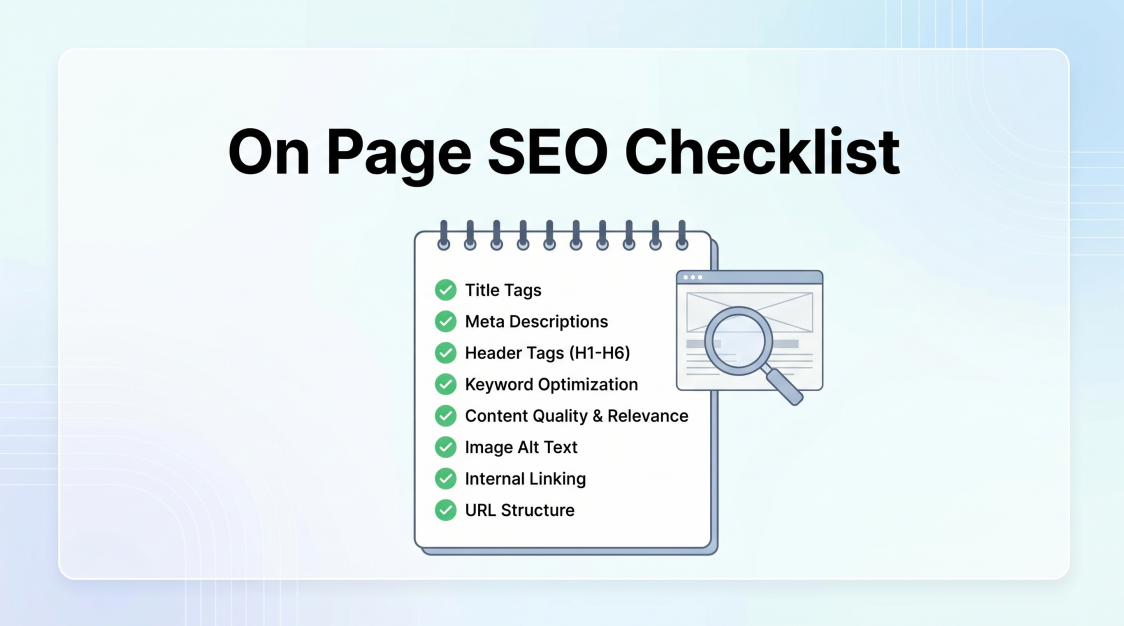
On page SEO Checklist is your single biggest lever for organic growth, and it’s entirely in your control. While off-page factors like backlinks require months of outreach, on-page improvements can move the needle within weeks. But in 2026, the rules have evolved. AI Overviews, zero-click searches, and Google’s smarter algorithms mean the old checklist of “put keywords in your title” is no longer enough.
This guide breaks down every essential on-page SEO factor, backed by the latest studies and real data, so you know exactly where to focus.
1. Keyword Research & Search Intent
Before you write a single word, understand why someone is searching. Search intent falls into four categories:
- Informational
- Navigational
- Commercial
- Transactional
Pages that perfectly match intent rank almost automatically, and those that don’t get outranked regardless of how polished the writing is.
Target one primary keyword per page with natural variations. Keyword stuffing is actively penalized by Google’s NLP models (BERT and beyond), which now understand context and topic relationships rather than just counting keyword frequency.
2. Title Tags & Meta Descriptions
Your title tag is still the most important on-page SEO element. A weak title destroys your click-through rate even from the #1 position. Keep titles under 60 characters, lead with your primary keyword, and make the value proposition clear.
Meta descriptions don’t directly affect rankings, but they drive CTR. A compelling 150–160 character description can increase organic clicks by 5–10%, which signals quality to Google and indirectly improves rankings over time.
3. Content Quality & E-E-A-T
Google’s 2026 ranking systems heavily reward Experience, Expertise, Authoritativeness, and Trustworthiness (E-E-A-T). This matters most for YMYL (Your Money, Your Life) topics, health, finance, legal, but it affects every niche. Over 92% of top-ranking YMYL pages now feature credentialed author bios.
Content quality is no longer about length alone. Updated content earns 3.4x more clicks than untouched equivalents according to Xpand Digital’s 2026 ranking study. Refreshing your top 20 pages outperforms publishing 20 new ones almost every time.
4. URL Structure & Internal Linking
Clean, descriptive URLs help both search engines and users. Keep URLs short, lowercase, and hyphen-separated. Avoid dynamic parameters, stop words, and dates in the URL unless date-relevance matters for your content type.
Internal linking is one of the most underused on-page tactics. It distributes page authority across your site, signals topical relevance, and reduces crawl depth for important pages.
5. Page Speed & Core Web Vitals
Google has confirmed Core Web Vitals as a ranking signal. The SISTRIX study found that domains meeting all three Core Web Vitals metrics (LCP, INP, CLS) gained 3.7% more search visibility compared to the 2.7% average. A Deloitte and Google study of 30.5 million user sessions found that even a 0.1-second speed improvement meaningfully impacts user behavior and conversions.
In 2026, slow pages lose twice, they rank lower in traditional search AND get ignored by AI crawlers that power ChatGPT, Perplexity, and Google’s AI Overviews.
6. Structured Data & Schema Markup
Schema markup tells search engines the specific meaning behind your content, not just what it says, but what it is. In 2026, this matters for both traditional search results and AI search engines. Properly implemented schema can earn rich results (star ratings, FAQs, how-to steps, breadcrumbs) that dramatically improve CTR.
7. Mobile Optimization
Google uses mobile-first indexing, meaning your mobile version is the version Google evaluates for ranking. A site that isn’t mobile-optimized loses up to 60% of its potential audience according to 2026 mobile SEO data. With over half of all web traffic coming from mobile devices, this is non-negotiable.
- Responsive design that adapts to all screen sizes
- Font size at least 16px on mobile
- Tap targets (buttons, links) at least 48x48px
- No horizontal scrolling or content overflow
- Test with Google’s Mobile-Friendly Test tool
Frequently Asked Questions
How long does on-page SEO take to show results?
Early improvements typically appear within 1–3 months. Solid ranking growth takes 3–6 months. For new domains, expect 6–12 months for competitive keywords. Technical fixes (like speed improvements) can show impact faster, sometimes within weeks.
How many keywords should I target per page?
One primary keyword per page, supported by 3–5 semantic variations and related terms. Google’s NLP models understand context, so naturally covering a topic well is more effective than forcing multiple keywords into the content.
Does on-page SEO still work with AI Overviews?
Yes. 76.1% of URLs cited in Google’s AI Overviews also rank in the top 10 of traditional search results. Strong on-page SEO is the foundation for AI visibility. Structured content, schema markup, and E-E-A-T signals all help get your pages cited in AI answers.
What’s the most impactful on-page SEO factor in 2026?
Search intent alignment is the #1 factor according to current SEO expert surveys. If your page doesn’t match what the user is actually trying to accomplish, no amount of keyword optimization will overcome that mismatch. After intent, content quality and Core Web Vitals are most impactful.
Is keyword density still important?
No. Google’s modern NLP models don’t count keywords, they understand meaning and context. Keyword stuffing is actively penalized. Focus on covering the topic thoroughly and naturally. If you write a comprehensive piece on a subject, your target keywords will appear naturally at an appropriate density.
Final Verdict
In 2026, on-page SEO has never been more important or more nuanced. The first organic result still captures nearly 40% of all clicks, and the top 3 results take over half. But getting there requires more than keyword placement. You need search intent alignment, genuine E-E-A-T signals, fast Core Web Vitals, structured data, and content that gets refreshed regularly.
The good news: every item on this checklist is within your direct control. Start with a technical audit (Core Web Vitals, mobile, schema), then move to content quality and intent alignment. Treat SEO as a system, not a one-time task and the compounding results will follow.